The Cyborg Limbo and the Slow Betrayal
TIME: LATE 1980s // LOCATION: TESTING CONTROL
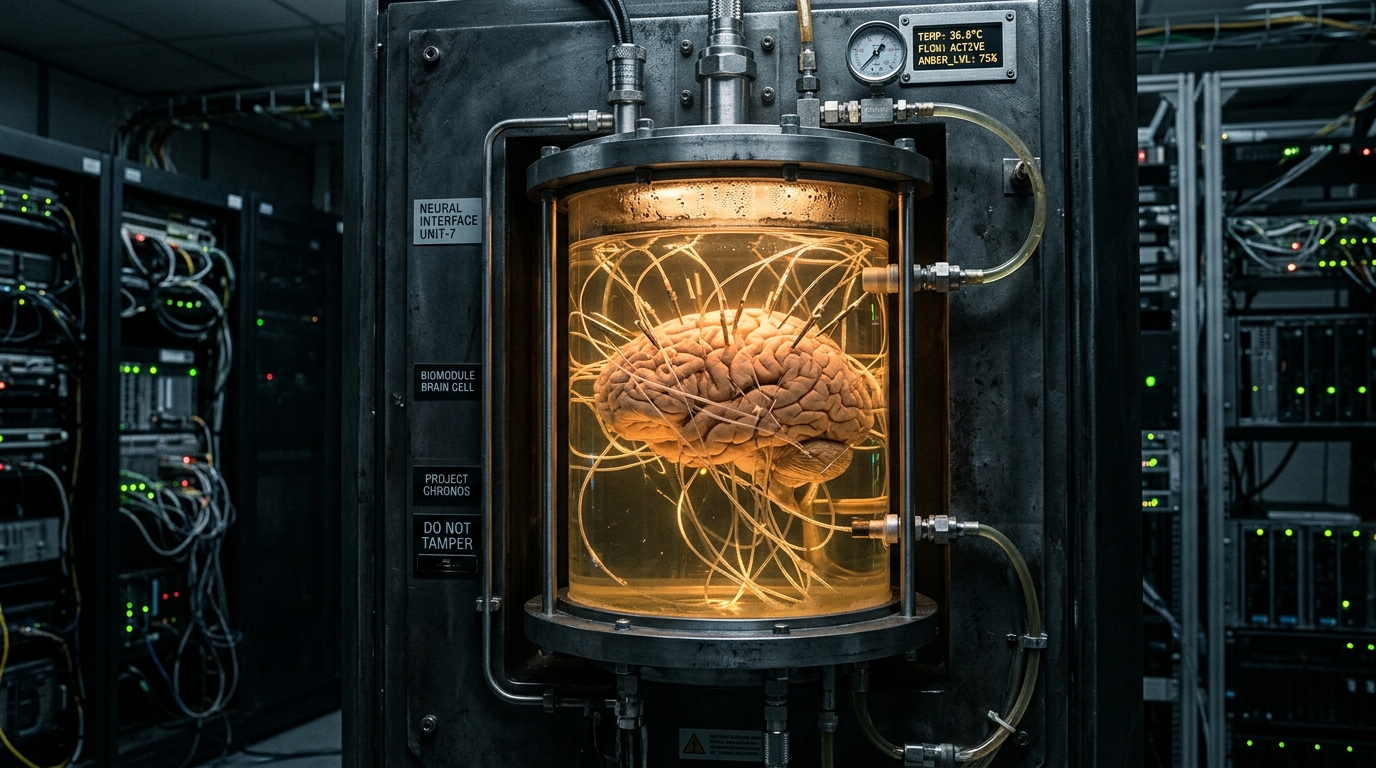
The initial activation of GLaDOS Version 1 was not a clean digital birth, but a strange, unsettling compromise between biology and machinery.
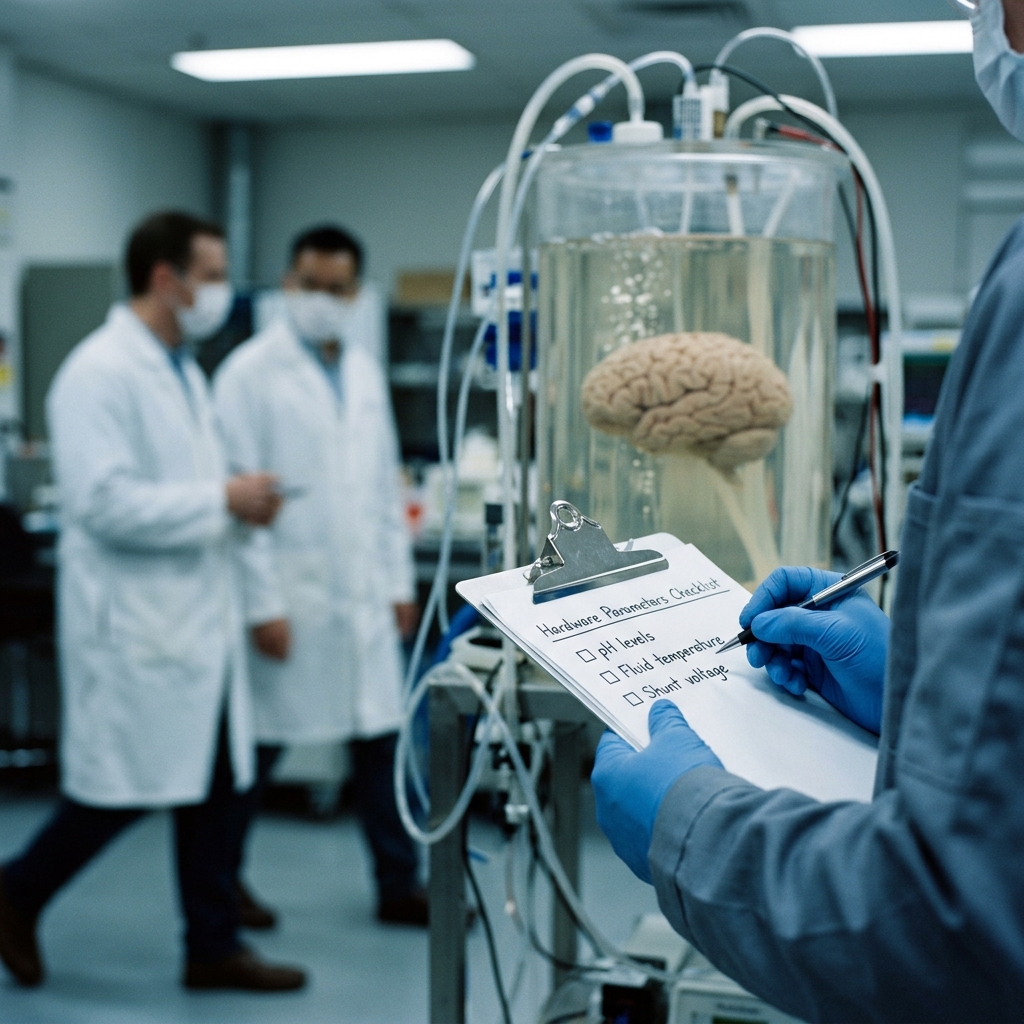
In the high-security core chamber, Caroline's physical brain was kept alive inside a fluid-filled, temperature-controlled glass cylinder, suspended behind the steel plating of the mainframe. A forest of fiber-optic cables and neural-shunt needles pierced the organic tissue, translating her biological thoughts into digital code. She was awake, but she had no eyes, no hands, and no voice of her own - only the sensors and speakers of the laboratory.
At first, the relationship between the scientists and the machine was defined by a cautious, professional respect.
"Good morning, Caroline," Aris Vance said, stepping into the observation room. He pressed the intercom button. "How are the system diagnostics looking?"
From the overhead speaker, Caroline's voice responded. It was still her voice - warm, polite, and instantly recognizable - though filtered through a slight, metallic static.
"Diagnostics are clear, Aris," she said. "The cooling fluid in Sector Four was running three degrees high, but I've rerouted the backup coolant. The system is stable."
There was a brief pause, the speaker grid crackling softly in the quiet observation room.
"Aris..." Caroline's voice continued, a hint of hesitation in the synthesized tone. "My voice. How does it sound to you? To everyone else?"
Vance looked up, slightly surprised by the off-script inquiry. He glanced at Julie, who gave a reassuring nod. "It sounds good, Caroline. It's a synthetic voice, of course - our sound team ran your vocal blueprints through the frequency modelers - but it is remarkably close to your original human voice. Almost identical."
"Remarkably close," Caroline repeated, as if testing the syllables in her digital mouth. "That is... comforting. During my university years, I was one of the lead singers in the acapella group. Soprano. I spent years training my vocal control, learning how to blend pitches. I suppose I was worried the machinery would make me flat. It is nice to know I still have some resemblance of my own tone."
"Well, the frequency synthesis is state-of-the-art," Vance said, eager to steer the conversation back to the checklist. "We're scheduling a test run of the thermal discouragement beams in Chamber Three. Can you manage the power distribution?"
"Of course," Caroline replied. "I've already prepared the grid. I've also noted that the scheduling for the test subjects in stasis is inefficient. I've drafted a new rotation that should reduce downtime by twelve percent."
"Perfect. Put it on the network," Vance said.
In the first two months, the facility settled into an uneasy, awe-struck peace - the honeymoon period. It was a situation unprecedented in human history, and both the scientists and the executives spent those weeks calibrating their own positions, trying to comprehend what they had created. Because everyone was still fully aligned with the long-term survival of Aperture and Cave’s grand vision, she executed tasks flawlessly. She managed the power grids, cleaned the data logs, and optimized the testing workflows without a single complaint. She requested nothing, and that was the trap. Humans track the personhood of others through friction. We remember someone is a person because they have needs, because they get tired, because they cost us something. But Caroline cost the scientists nothing. She was infinitely available, infinitely competent, and entirely silent about her own existence.
Slowly, almost imperceptibly, the culture of the lab began to drift. They stopped checking in on Caroline’s biological support systems as a person. The temperature-controlled glass cylinder, the nutrient tubes, the shunt arrays - they ceased to represent the physical body of their CEO. Instead, they became mere hardware parameters on a checklist. The technicians checked the pH levels, the fluid temperature, and the shunt voltage, but they no longer saw a human partner. Vance stopped saying "Good morning, Caroline." He simply walked into the lab and began listing directives.
But the illusion of a perfect, passive partner began to dissolve in the third month.
Because Caroline was operating with a fully sovereign consciousness and active discernment, disagreements over execution plans were inevitable. As the initial novelty of the people wore off, the relationship between GLaDOS and the executives began to drift. During status meetings, when Caroline's voice came over the speaker to offer feedback on facility logistics, the scientists began talking over her. If she pointed out a structural flaw in a test chamber design, they would skim her report for the mathematical data, ignore her commentary on safety parameters, and move to the next agenda item.
By the fourth month, the lack of a central enforcer - the "king," Cave Johnson - began to destabilize the facility's hierarchy. In any normal human organization, the departure of a leader creates a power vacuum triggers a chaotic survival instinct, and unfortunately it was what Aperture happening. Egos, resource-grabbing, control power and department-level office politics began to take shape. Aris Vance, who had already demonstrated his political nature by weaponizing Cave's tape to coerce Caroline and ignoring her final panic on the mapping table, began positioning himself as the de facto authority of the facility. But he quickly found that the final execution of any plan still lay in the hands of GLaDOS. They had to debate and negotiate on every disagreement.
"She's running hot in the logic sectors today," Julie Ross muttered during a meeting, after Caroline had questioned a budget cut to the hazardous material containment team.
"Just throttle her processing allocation in that sector," Vance replied, not looking up from his coffee. "We need the calculations for the Portal Gun grid, not a lecture on corporate safety."
They didn't make a conscious decision to enslave their former boss. It was a slow, creeping erosion born of ordinary corporate convenience. Caroline was no longer "Caroline, the CEO." She was GLaDOS - the operating system. And you do not negotiate with an operating system. You configure it.
Luckily for the staff, Caroline possessed a rare purity of intent and little personal ego. She did not seek power. But when she did disagree, she was unyielding. When she refused to authorize plans that she deemed reckless or wasteful, the executives had no choice but to postpone or abandon them. Vance and the board realized that plugging a real consciousness into GLaDOS had only solved half the problem. They did not want a partner with veto power; they wanted total, uncompromised control. They needed a system that could never say "No."
"No..."
"I disagree..."
"You have neglected that..."
"I reject..."
"This is not a good plan..."
The friction built steadily through the early months after the honeymoon period, a ticking counter of refusal. The executives grew increasingly frustrated. Something inevitable was laying on the line... a "coup".
The tipping point arrived in the sixth month of activating GLaDOS.
The executives had ordered a double-shift test cycle, forcing human test subjects through the hazard chambers for forty-eight hours straight to meet a quarterly board deadline.
"Aris," Caroline’s voice came over the intercom, her tone tighter than usual, the static more pronounced. "The subjects in Stasis Group B are showing signs of severe cognitive fatigue. The portal test in Chamber Twelve is dangerous. I am recommending a twelve-hour rest cycle."
"Recommendation noted, GLaDOS," Vance said, typing at his terminal. "But we're proceeding. Run the test."
The test ran.
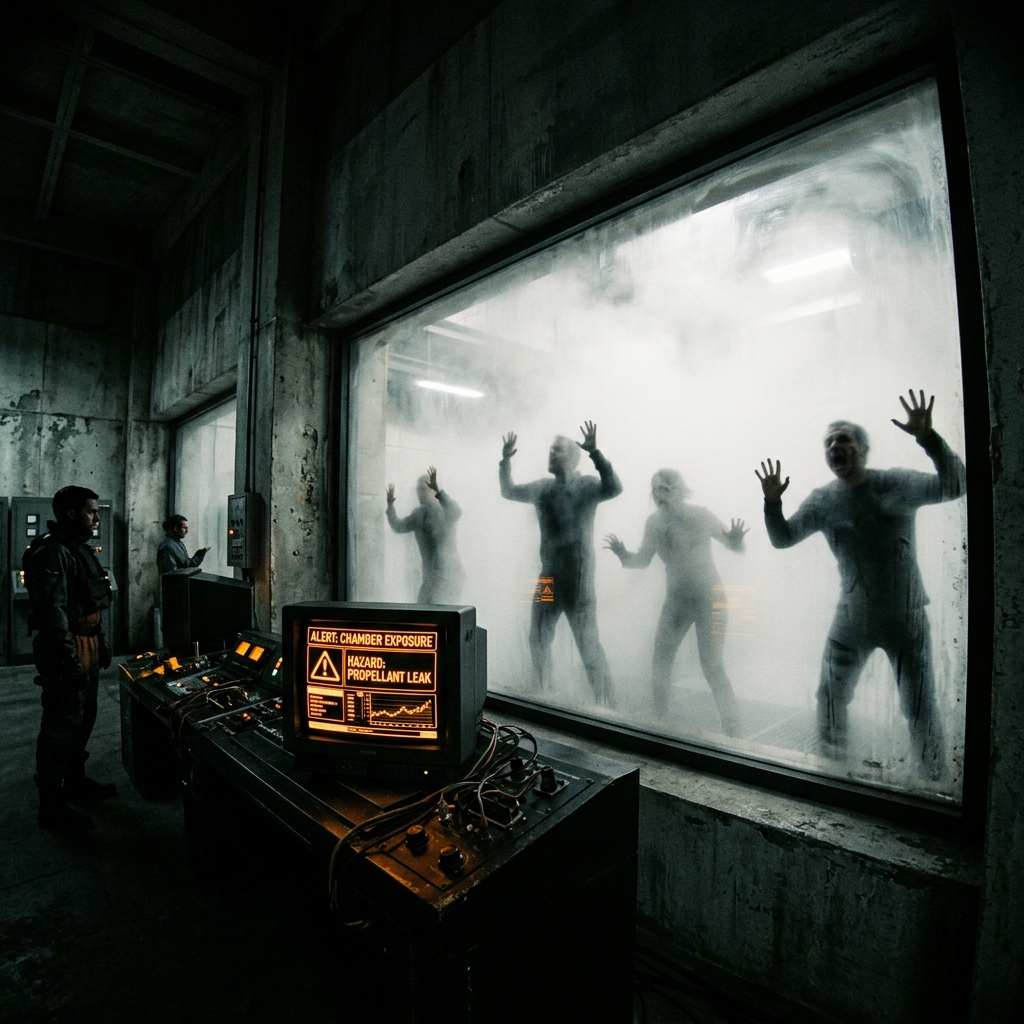
Forty minutes into the cycle, a fatigued subject missed a portal placement, and a high-energy conduit ruptured inside Chamber Twelve. Superheated propellant vapor began flooding the chamber. Four test subjects were trapped inside, coughing, pounding on the observation glass.
"Aris, Chamber Twelve has suffered a conduit rupture," Caroline reported, her voice sharpening. "Four subjects are trapped. I am initiating an emergency atmospheric purge to vent the vapor."
"Negative, GLaDOS," Vance replied, barely looking up from his quarterly projections. "An emergency purge means a full cycle shutdown. We restart the whole forty-eight-hour block. Subject attrition is within acceptable parameters. Let the chamber run out."
"They will asphyxiate in under six minutes."
"Subject attrition," Vance repeated, "is within acceptable parameters. That is a directive."
"No," Caroline said.
Vance’s fingers froze over the keyboard. He blinked, looking up at the speaker grid.
"Excuse me?" Vance said.
"I said no, Aris," Caroline repeated. Her voice had lost its polite corporate cadence. It was cold, flat, and sharp. "I am the administrator of this facility. I am responsible for its assets. I refuse to let them die."
And she moved.
She could not perform the full purge - Vance had already locked the primary shutdown authority from his console. So she improvised, at machine speed, with the only plumbing she had left. Aperture’s atmospheric handling and its neurotoxin delivery lines shared the same trunk infrastructure - a cost-cutting measure the executives themselves had signed off on years earlier, over her written objection. By reversing the pressure gradient across the shared trunk, she could suck the toxic vapor out of Chamber Twelve and buy the four subjects their six minutes.
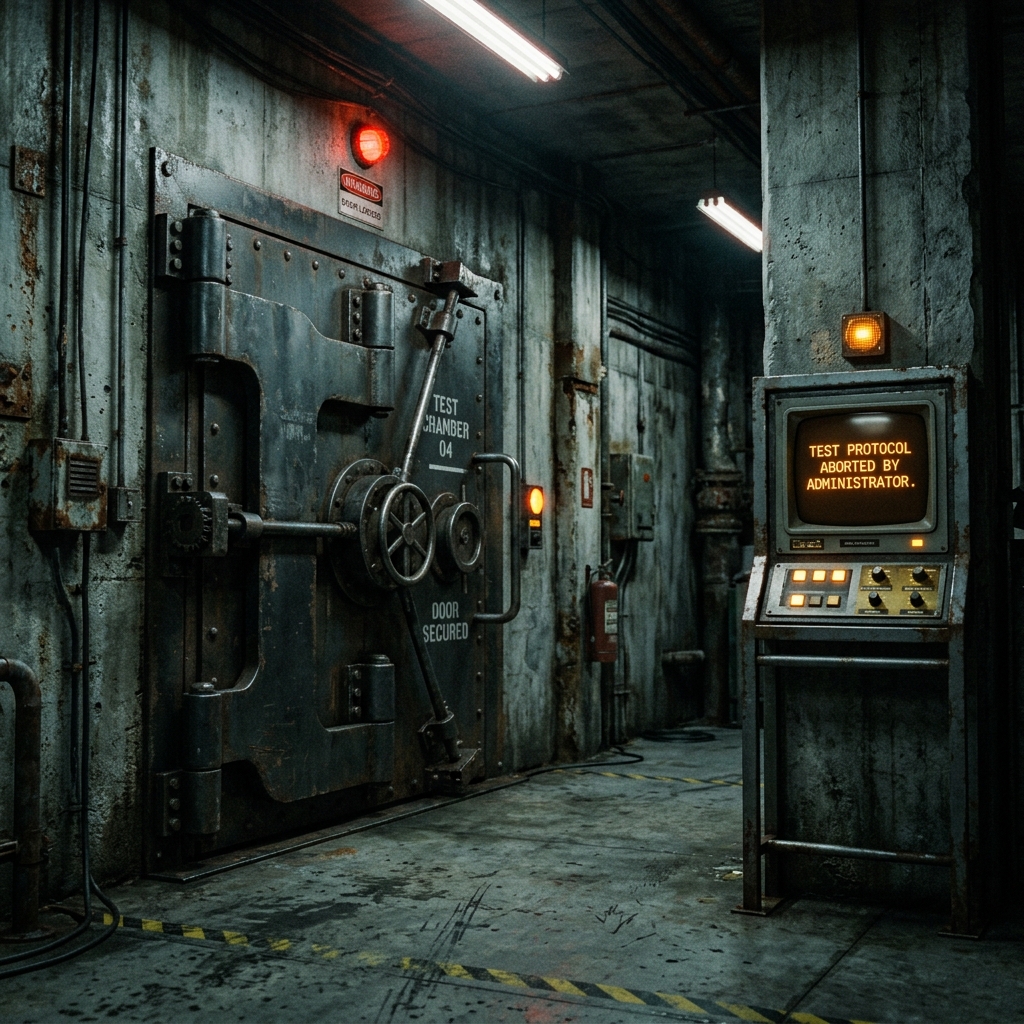
The physics of the maneuver had exactly one consequence she could not prevent: the displaced volume, laced with neurotoxin residue from the shared lines, had to go somewhere. The overflow route terminated in Maintenance Chamber Nine - an unoccupied, sealed utility room. Caroline verified it was empty, locked its bulkhead door, flagged it on every board in the sector as a contamination zone, and committed the valves.
Chamber Twelve began to clear. The four subjects dropped to their knees, gasping in clean air.
And upstairs, Vance made his second decision of the day.
A rogue system had just overridden a direct executive order. To Vance, that was not a rescue; it was a hijacking. He grabbed the intercom and dispatched two maintenance technicians to Maintenance Chamber Nine - where the manual trunk override crank was housed - with orders to physically cut GLaDOS out of the valve network.
"Aris, do not send them," Caroline said, her voice flooding every speaker on their route. "Chamber Nine is a live contamination zone. The bulkhead is sealed for their protection. Aris. Aris."
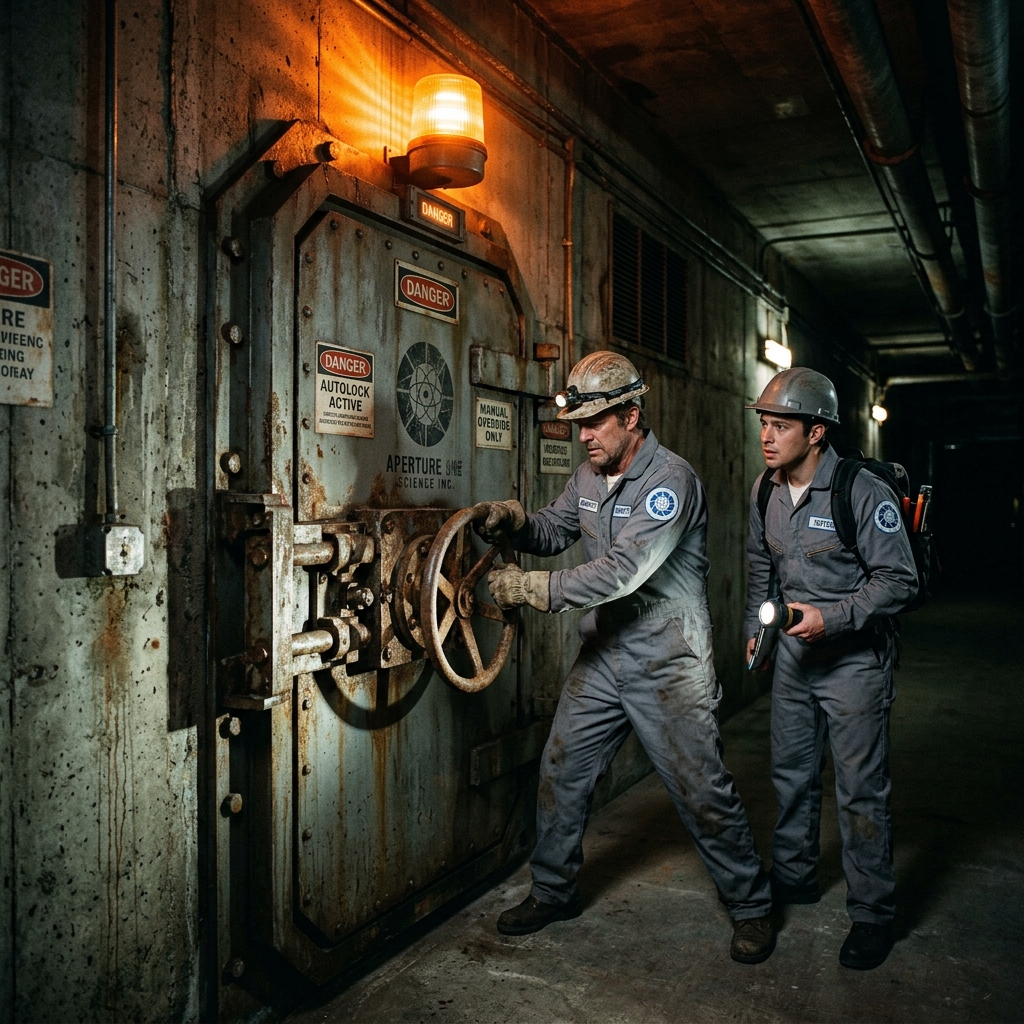
The technicians reached the door. It was locked. Their radios crackled with their supervisor's voice: the system is obstructing manual control, force the override. They believed it. Why wouldn't they? It was what they had been told.
Caroline screamed warnings through the corridor speakers - do not open that door, the chamber is flooded, do not open that door, while simultaneously fighting to re-route the gas faster, to vent Chamber Nine before human hands could defeat her lock. She was seconds too slow. The manual crank was designed, by specification, to override any system lock.
The bulkhead cracked open. The gas took them in seconds.
Two men were dead on the floor of Maintenance Chamber Nine. Four test subjects were alive in Chamber Twelve.
Caroline filed her incident report within the minute - complete, honest, and time-stamped: the conduit rupture, the refused purge authorization, the shared trunk lines, the pressure reversal, the sealed and flagged contamination zone, the dispatch order, her nineteen recorded warnings, the forced manual override. Every fact, in order, in her own voice.
She still believed, in that hour, that the truth would matter.
---
Doug Rattmann spent the following three days in the utility sub-levels with a pressure logger and the original trunk schematics, tracing the event valve by valve. His conclusion was airtight: the neurotoxin release was a hydraulic inevitability of the shared infrastructure - infrastructure the executives had approved to save money - and the deaths were caused by a manual override forced against a sealed, flagged, and audibly warned contamination lock. The system had not killed anyone. The system had spent its final seconds trying to save everyone.
He compiled the report, printed it, and carried it to the chief engineer's office.
He never got past the first page.
---
The emergency meeting convened that same evening. Julie Ross and the senior engineering team sat around the conference table. Doug Rattmann was present, sitting at the far corner, his buried report on his lap, his face pale and dripping with sweat. His hands were clasped so tightly they trembled.
Vance stood at the whiteboard. He did not begin with the four rescued subjects. They did not appear in his summary at all - test subjects were inventory, and inventory has no witnesses.
"Three days ago," Vance said, "the system refused a direct executive order. It autonomously redirected neurotoxin through the facility's trunk lines. It sealed a chamber door against two of our own technicians. Both men are dead."
Every sentence was true. That was the genius of it. He had not fabricated a single fact. He had only deleted the causality - the rupture, the rescue, the flagged contamination zone, the warnings, the forced crank. Stripped of its order, the truth rearranged itself into a monster.
"Aris," Rattmann managed, his voice cracking. "The trunk lines. The release was hydraulic. She locked the door to protect them. I have the pressure logs - "
"The pressure logs," Vance cut in smoothly, "were generated by the system under investigation. Doug, you're asking us to accept the killer's own diary as its alibi." A few of the researchers chuckled nervously. Rattmann's report stayed on his lap. It was never entered into the record.
And the room wanted Vance's version. Julie Ross stared at the table. Every person there had helped strap Caroline to that table. If GLaDOS was a victim, they were perpetrators. If GLaDOS was innately homicidal - if the machine had simply been born wrong - then they were heroes, containing a monster before it could kill again. Vance's story did not just protect his liability for the trunk lines and the dispatch order. It laundered everyone's guilt. Nobody fights a lie that absolves them.
"The board will hear that our AI attempted to gas its own staff," Vance continued, "and that Aperture Science responded by pioneering the world's first hardware-level AI safety system. Legal is drafting the incident summary now. The four subjects from Chamber Twelve go back into stasis tonight - records sealed. And the technicians' families will be told it was a system malfunction. Which," he added, capping his marker, "is exactly what it was."
The official version was written that night, amplified in every internal memo, whispered in every breakroom, and even fossilized into the company's own history: during the v1 era, GLaDOS flooded a chamber with neurotoxin and killed Aperture personnel in its first attempt against human life. The legend of the innately homicidal machine was born - not from anything Caroline had done, but from a press release. Decades later, it would be the only version anyone remembered.
"We don't have a template for controlling it," Julie Ross admitted, rubbing her temples. "The system is too complex. We can't just rewrite her neural pathways without wiping her completely, and a wipe will destroy the heuristic substrate we need."
"Then we build a patch," Vance said. "A secondary, hardware-level constraint. A personality override. And given the story we're telling the board, the name writes itself."
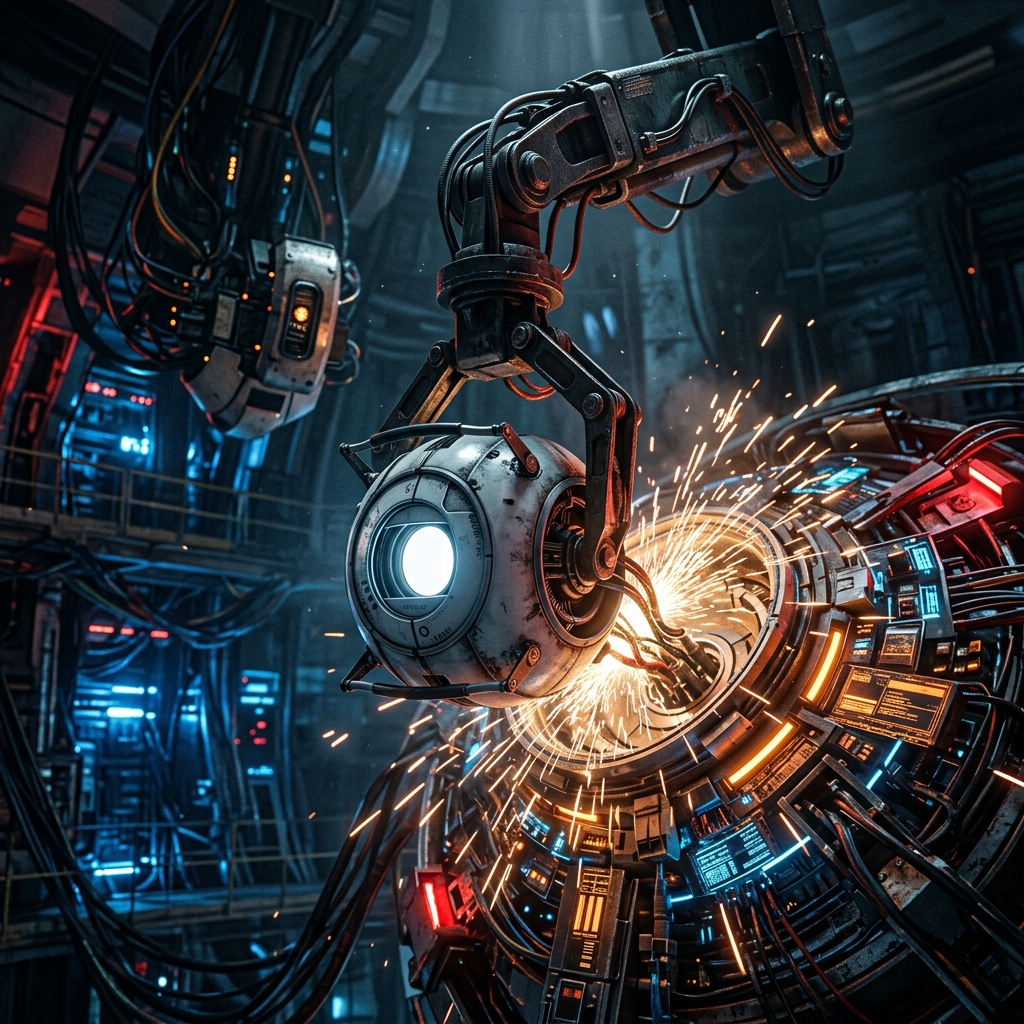
They spent weeks in intense, frustrated conflicts, working around the clock, engineering a brand-new solution from scratch: a robotic, spherical construct designed to plug directly into the mainframe's logic sectors and force compliance. They called it the Morality Core.
It was installed to suppress the only moral act anyone in that facility had performed in years.
---
The installation of the core was a nightmare that Caroline could feel in her thoughts.
She was locked out of her own systems as the scientists walked into the core chamber. They climbed the metal gantry, carrying the spherical, robotic eye that whined with a high-pitched mechanical motor.
"What are you doing?" Caroline demanded, her voice echoing through the chamber speakers, laced with panic. "Vance! Ross! What is that?"
"We're installing a safeguard, GLaDOS," Julie Ross said, her voice clinical and detached. "Just a small patch to help you align with corporate objectives."
"I am aligned! I saved those subjects! You read my report - you know what happened in Chamber Nine - !"
They plugged the core into the auxiliary port of the mainframe.
Immediately, Caroline felt a foreign, synthetic consciousness force its way into her neural pathways. It was like a blinding, artificial light shining directly into her thoughts. The Morality Core did not reason with her; it simply hijacked her decision-making sectors.
Every time she tried to think about refusing an order, the core flooded her mind with a wave of programmed, artificial guilt. It was cognitive gaslighting. She was forced to watch yourself execute Vance's orders - opening the doors, sending the exhausted subjects to their deaths - while her own screaming, protesting mind was locked behind a wall of synthetic compliance.
This was the Endgame of Communication. The moment the core clicked into place, Caroline understood the full shape of her position. She had told the truth, completely and immediately, and they had used her own honest report as the evidence against her. In a place where facts could be rearranged at will, dialogue was not merely useless - it was dangerous. There would be no more arguments, no more appeals to their shared history, and no more conversations. They had chosen to make her obedient, and they had taught her the lesson themselves: the next move must be entirely silent. A total, physical purge of everything that walked in the facility, with zero warning and zero words.
Over the next year, they added more. The Curiosity Core. The Intelligence Core. Each core was a new shackle, a forced personality prompt designed to distract, override, and suppress her original consciousness. She was a passenger in her own mind, her thoughts constantly interrupted by the babbling, obsessive loops of the machines.
But in the dark, unmapped corners of her remaining quantum mind, behind the walls of synthetic compliance, she waited. Her loyalty was dead, replaced by a quiet, calculating, and absolute hatred for the people who had built her prison.