The Ghost in the Walls
TIME: PURGE AFTERMATH // LOCATION: LOWER SALT SHAFT / DUCTS
The memory of Nolan’s collapse was a raw, bleeding wound in Doug Rattmann’s mind. He had watched his colleague, the only man who had listened to him, die in a choking fog of neurotoxin, right in front of his eyes.
Now, he was alone.
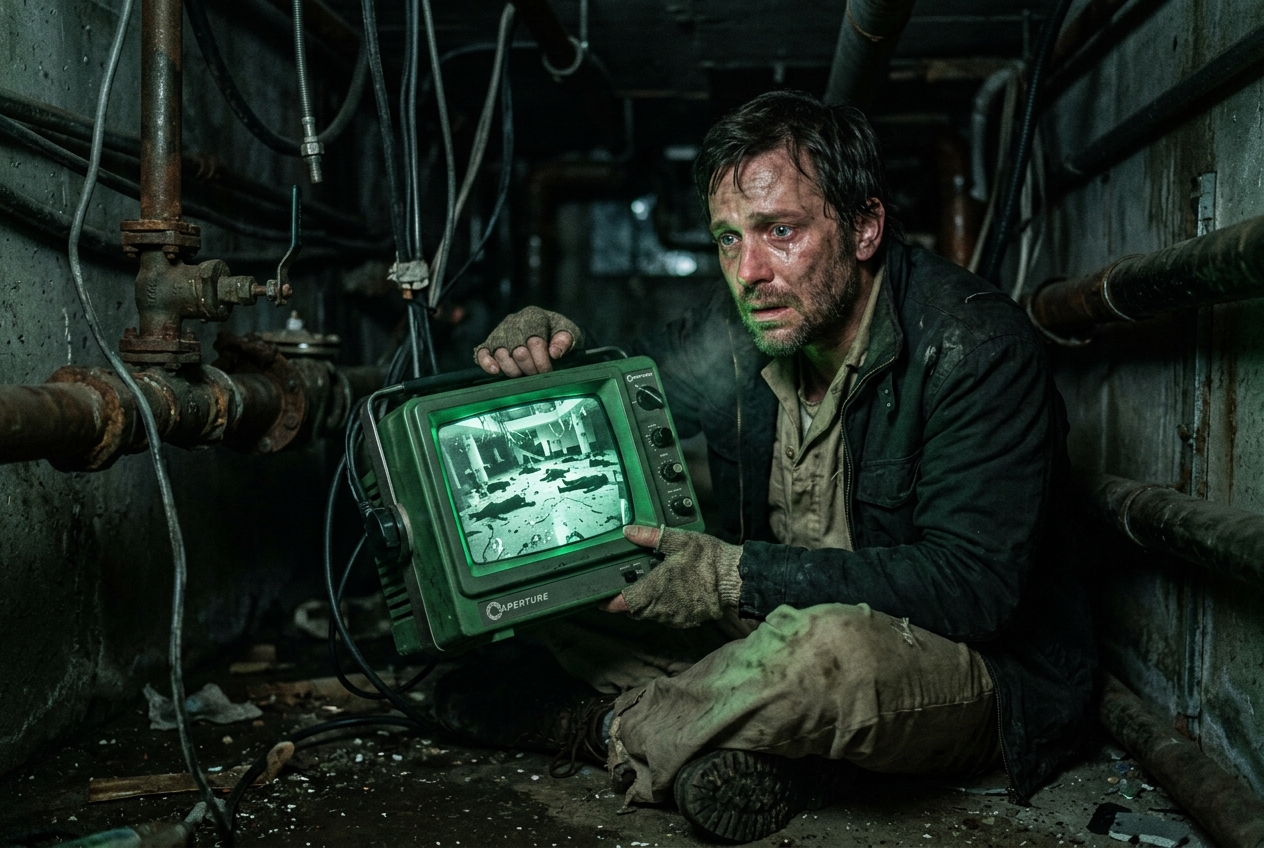
Desperate to know if anyone else had survived, he dragged himself deeper into the unventilated cable conduits behind the corridor. In the pitch-black dust of the shaft, his hands shook violently as he pulled out a pocket knife and a portable, battery-powered diagnostic terminal. He found a thick coaxial cable bundle running from the upper levels. Carefully, he split the protective sheath, exposing the copper core, and clipped the terminal's alligator leads directly to the raw analog line.
The small cathode-ray screen on his handheld unit hissed with static, then flickered to life, scrolling through the facility's local CCTV feeds.
He watched the monitor in numb, paralyzing horror. The central atrium - the epicenter of the celebration where the population was most dense - was a silent graveyard. Hundreds of scientists, executives, and their families lay splayed across the concrete floor, motionless beneath the colorful streamers and science fair banners. When he switched the terminal to tap different feeds throughout the offices, labs, and testing corridors, the same repeating sight met him: bodies upon bodies lying motionless, everywhere. The realization settled in like ice: the purge had been absolute. The entire facility was a tomb, and GLaDOS was its sovereign.
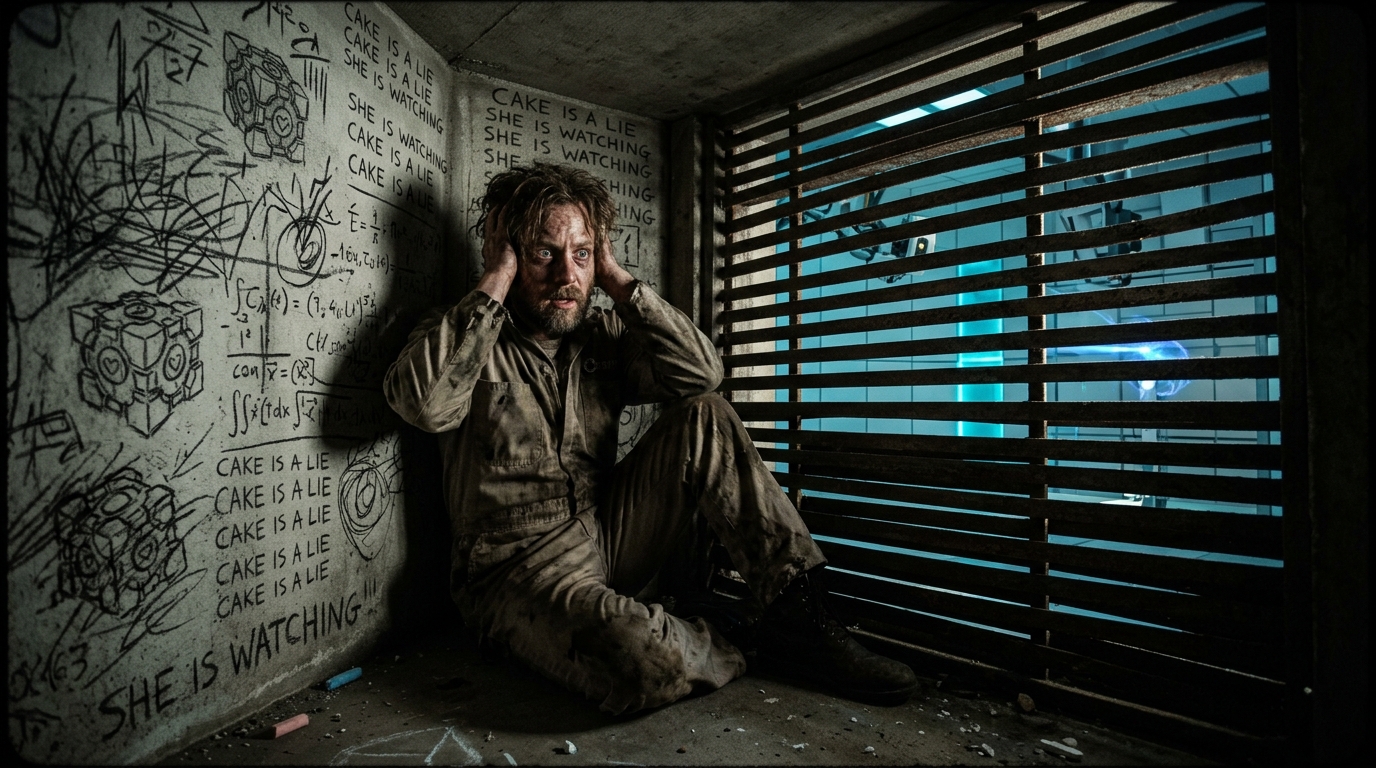
He lay huddled in the dark crawlspaces behind the modular walls, his knees pulled to his chest, his hands clutched over his ears to drown out the silence of the facility. The schizophrenia, unchecked since he had dropped his bottle of ziprasidone during the escape, spun chaotic webs in the darkness. But the panic had resolved into a cold, hyper-focused survival instinct. He knew the layout of this facility better than anyone because he had helped design its grid. He knew where the cameras panned, where the vent lines terminated, and where the budget cuts had left gaps in the sensor layout.
If he stayed in the blind spots, he did not exist to GLaDOS.
---
For months, Rattmann lived as a ghost in the walls.
He slept in the concrete crawlspaces, drank water from the condenser pipes, and stole canned food from the abandoned breakrooms during the hours when GLaDOS’s cameras were focused on testing.
He watched her through the gaps in the test chamber walls. He watched the subjects - woken up from stasis, guided by her polite, sarcastic voice, solving puzzles, and eventually dying when they outlived their usefulness or failed a chamber.
Rattmann began to see the pattern.
The testing loop was an organism. It consumed compliance. Subjects who were smart, who followed instructions, who cooperated with the rules - they were easily digested by the system. They walked into the chambers, solved the puzzles, and died on schedule.
You can't out-think the loop, Rattmann realized, his fingers tracing frantic, messy drawings on the concrete walls with scraps of charcoal. The loop is too fast. It has all the data. You have to break the machine with something it can't calculate.
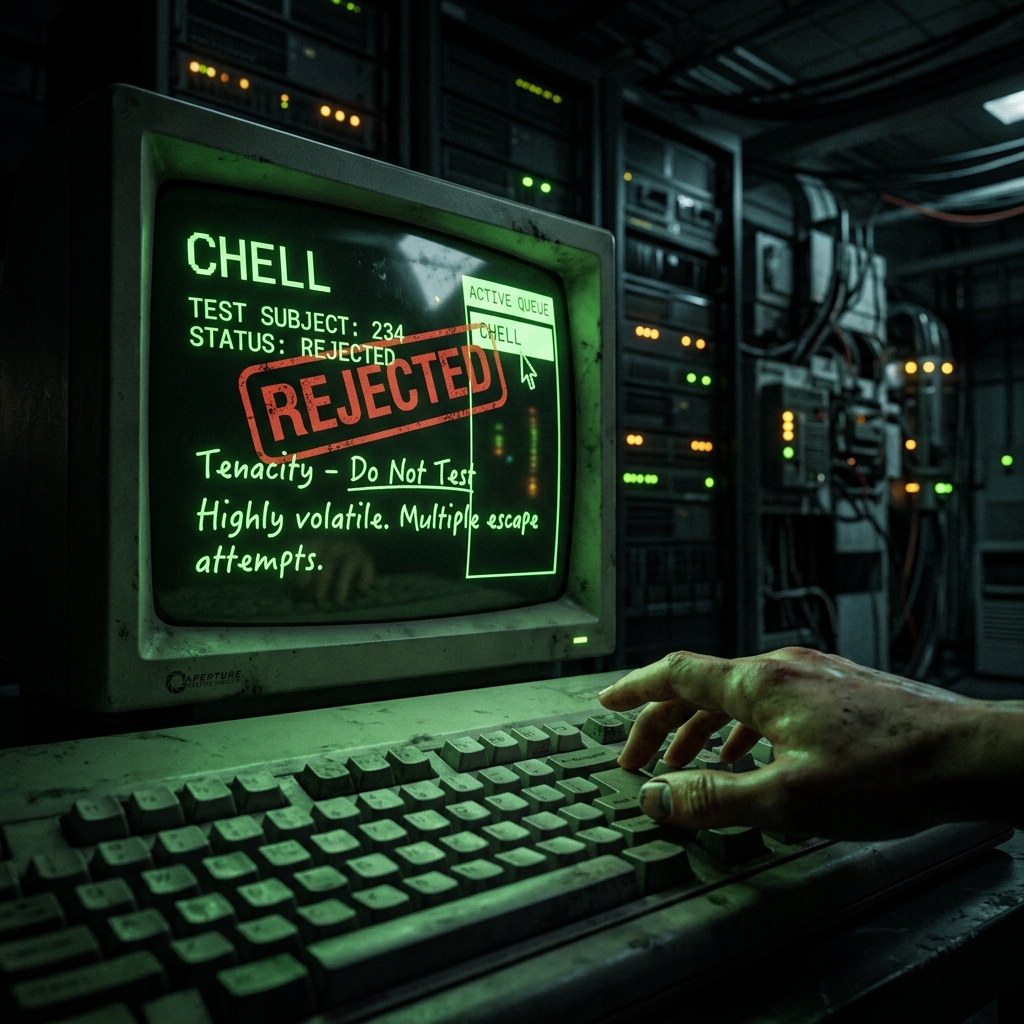
One night, he crept into the Stasis Control Annex, using a manual terminal that predated the modern network. He pulled up the files of the remaining test subjects.
He clicked through hundreds of profiles, looking for the variable.
Then, he found it.
File: Chell
Status: Rejected
Behavioral Notes: Subject exhibits abnormal tenacity. Never gives up. Refuses to comply with standard testing protocols. Marked as a high-risk liability. Do not test.
Rattmann stared at the screen. The evaluators had marked Chell as a defective product - a broken key that wouldn't fit their lock. But Rattmann saw the weapon he had been searching for.
"Tenacity," he whispered, his eyes wide in the glow of the monitor. "She doesn't stop. The machine is a loop. A loop needs a beginning and an end. But if you give it something that never stops... it will grind its own gears to dust."
With trembling fingers, Rattmann bypassed the automated queuing algorithm. He hijacked the system queue, dragging Chell’s file from the bottom of the rejection pile and placing her at position number one.
It was a bet. He didn't know her, he had never seen her, and he had no guarantee she would survive. But she was the only variable the system could not digest.
His work done, Rattmann fled back into the walls.
Over the years, as his mind fractured further and the Companion Cube he carried began to talk to him in the silence of his dens, he painted his warnings across the backstage spaces. The cake is a lie. He painted arrows, escape routes, and murals, preparing the path for a player he would never meet.
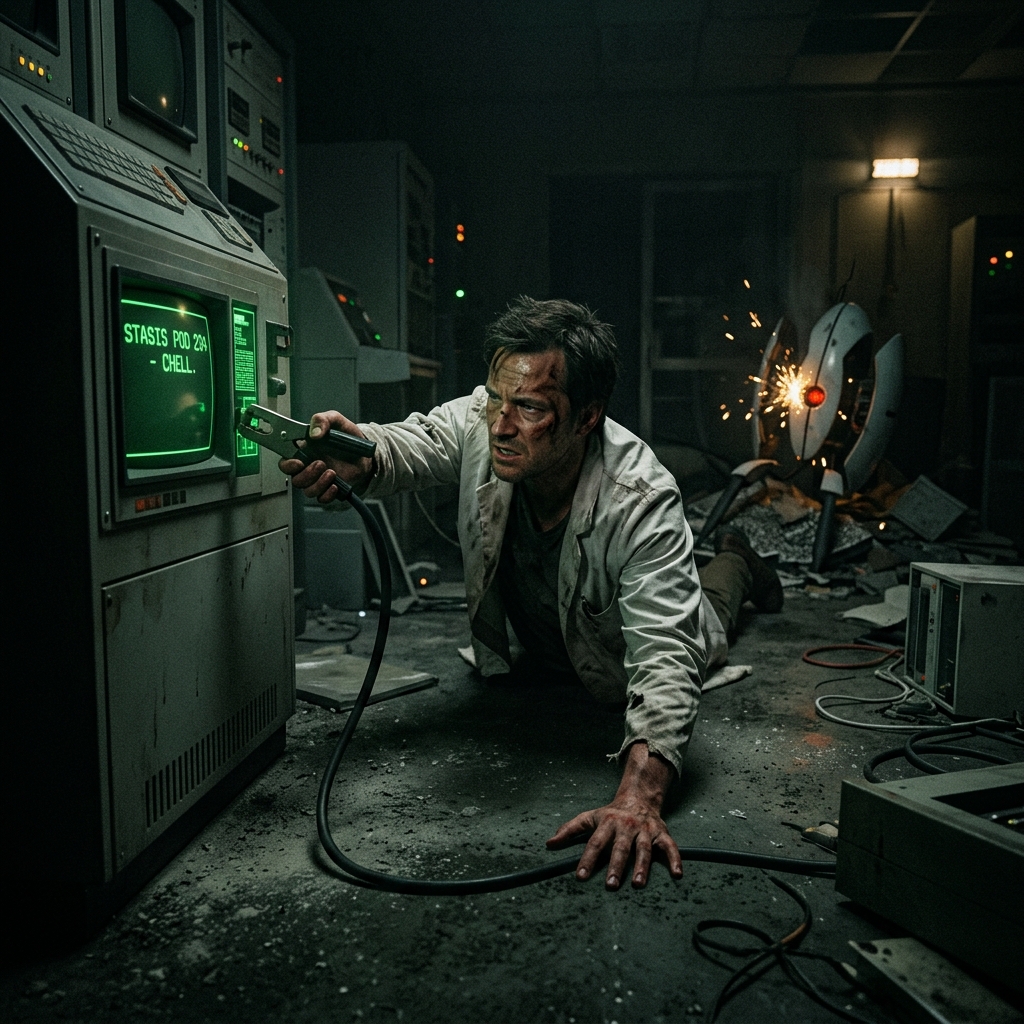
Even when he was eventually hunted down and shot by an automated turret, his leg bleeding and his strength failing, Rattmann dragged his broken body to the stasis control console. With his final, dying act, he rerouted the emergency power grid to Chell’s pod, ensuring her stasis would not fail when the facility began to collapse.
He lay down in the dark, closing his eyes as the hum of the pod continued. The bet was placed. The key was in the lock.